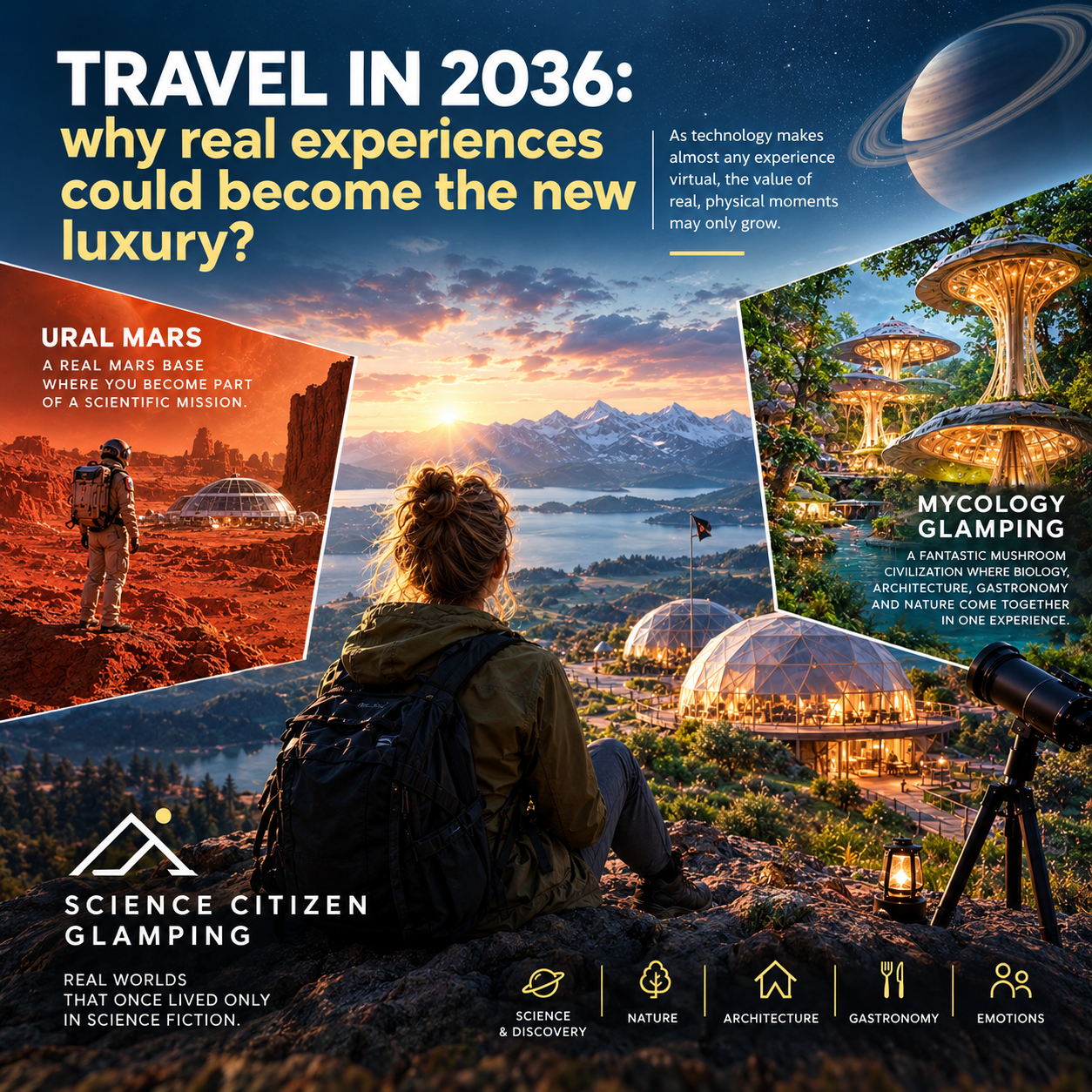
I've been thinking a lot lately about what, the world will look like in ten years. Which industries will disappear, which will transform, and which, on the contrary, will receive a powerful impetus for development? Where will new capital be created? And what place will tourism, the experience industry, and projects, like Science Citizen Glamping occupy in this future?
Together with artificial intelligence, I analyzed several scenarios of technological development on the horizon of 2036. We looked at the impact of AI, robotics, virtual reality, changing consumer habits, and the experience economy.
One of the most interesting findings is the following:
"The more humanity immerses itself in the digital world,the higher the value of real physical experience can become.
It is on this hypothesis that our concept of Science Citizen Glamping is largely based.
01. The world of 2036: when almost any experience can be generated
Let's imagine a relatively likely scenario of technology development for the next ten years.
Artificial intelligence creates movies, music, images, and virtual worlds almost without human input. Personalized digital entertainment is becoming more accessible. Robotization is gradually changing the labor market, and virtual and augmented reality allow you to simulate the most incredible spaces.
Perhaps, in ten years, a person will be able to put on a virtual reality device and be on the surface of Mars. They will be able to walk through a fantastic forest, meet digital representatives of an alien civilization, or explore a virtual ecosystem, that never existed.
And all this will be relatively inexpensive.
A natural questionarises: Why should a person go-somewhere, if technology can provide almost any impression of home?
At first glance, it seems, that this is a serious threat to the tourism industry.
But I also see the opposite scenario. The more advanced virtual reality becomes, the more clearly the value of, something that cannot be fully reproduced by digital means can manifestitself.
"Real cold.
- The smell of the forest after the rain.
"The warmth of a campfire.
- Physical fatigue after climbing mountains.
- Taste of an unusual dish.
- Touching unfamiliar material.
The feelingthat you are really in a different place, and not watching its simulation.
The digital environment can have a convincing effect on vision and hearing, and over time, it can better reproduce tactile and other sensations. But real travel involves more than just sensory cues.
It is also a physical presence, the unpredictability of the environment, interaction with other people and the understanding that, what is happening exists regardless of the digital scenario.
It is here, in my opinion, that an interesting niche opens up for tourism of the future.
02. The Experience Economy: Why People will pay to participate, not just to watch
Traditional tourism has long been built around a relatively simple model:
A person buys transportation, accommodation, food, and access to a particular attraction. But gradually, the center of consumer value is shifting.
Today, it is not enough just to build a beautiful hotel complex or restaurant.
The consumer is increasingly offered not a place, but a scenario for staying in this place. Not just a room with a mountain view — but an opportunity to spend a few days in an unusual environment. Not just a dinner — but a gastronomic journey with its own history.
Not just an excursion — but participation in a process, that evokes emotions, requires action, and leaves memories.
This trend is usually considered within the framework of the experience economy — the economy of impressions.
But I think, that in the next ten years it can move to the next level.
From the economy of impressions to the economy of physical participation. In this model, a person ceases to be a passive consumer. He becomes a participant in what is happening.
For example,you can watch a movie about a Mars expedition. You can complete a computer game, dedicated to the exploration of Mars. You can visit the exhibition about space.
Or you can live for a few days on an analog Martian base, where the surrounding architecture, living conditions, scientific activities, food and interaction scenarios are combined into a single system.
These are fundamentally different products.
The first one sells content.
The second is the ability to physically experience an unusual experience.
And here comes an important assumption: as digital content becomes cheaper, a well-designed physical experience can become relatively more valuable.
This does not mean, that all tourism will automatically become more expensive. Rather, the market will be more divided into mass offers and truly unique formats.
03. Science Citizen Glamping: not just a tourist object, but a physical world with its own reality
It is in this direction that we are developing the concept of Science Citizen Glamping— глэмпингов гражданской науки.
I don't see this project as a chain of unusual hotels. And not just as-popular science tourism.
Our idea is to create physical thematic worlds, in which people can live, interact with the environment, participate in research and receive impressions through direct contact with reality.
The concept is based on three elements: Science. Architecture. Diving.
- Science creates a meaningful basis for the project.
- Architecture creates a special environment.
- And participation scenarios turn your stay into a full-fledged journey inside this environment.
However, we do not seek to replace reality with a virtual simulation. Conversely. We want to make reality so unusual, that it is perceived as science fiction.
And here I see two particularly significant areas of our concept.
04. URAL MARS — a few days at an analog Mars base
The first pilot project of Science Citizen Glamping is "Ural Mars Mars Base".
This is a scientific-and tourist complex, created in the style of a Martian research base. It is based on an unusual natural landscape, modular architecture, astronomy, geology, and-popular science scenarios.
But I would like, the guests to see it not just as a beautiful glamping experience with a space design. A person should feel like a participant in a Martian research mission.
Imagine. You arrive at a territorywhose architecture resembles an autonomous base on another planet. Instead of the usual hotel buildings — residential modules. Instead of the standard reception, there is a central research hub. All around is an unusual landscape, metal walkways, technical structures, and an astronomical observatory.
The whole space is united by one idea.
But the most interesting thing does not start at the moment of check-in. And when a person begins to interact with this world.
What can be included in the guest experience?
- Astronomy. Observation of the real starry sky through telescopes. Study of the moon, planets and other astronomical objects under the guidance of specialists.
- Geology. Research of local rocks, get acquainted with the geological history of the territory, work with samples and equipment.
- Scientific missions. Participate in specially designed research tasks, based on real scientific methods.
- Experimental environment. Familiarization with the principles of functioning of autonomous research bases, engineering systems and technologies, used in the space industry.
- Themed gastronomy. Dishes, inspired by the ideas of autonomous food, space expeditions and future extraterrestrial settlements.
- Team interaction. Collaborate on missions, solve problems, and work in small research groups.
At the same time, it is important to draw a border: Ural Mars is not a real Mars station and not a professional cosmonaut training center.
It is a physical science-fiction environment, where real scientific knowledge and methods become the basis of the tourist experience. It is this combination that I find particularly interesting.
Why can't this be completely replaced by VR? In virtual reality, you can see the surface of Mars. But seeing Saturn through a real telescope, feeling the night chill, hearing the wind, and being close to other participants, is a different experience.
You can view a digital model of the rock formation. But taking a real sample, looking at its structure, and trying to determine its origin is a completely different process.
You can play the space mission simulator. But living for a few days in a physically existing complex, where the whole environment is subordinated to a single concept, is a different level of involvement.
We are not selling the illusion of presence. We create a place, where a person is truly present.
05. MYCOLOGY GLAMPING-a journey inside the mushroom civilization
The second direction, which I consider particularly promising, is mycological glamping. And here the possibilities for creating an unusual physical experienceare perhaps even wider.
Imagine not an ordinary recreation center in the middle of the forest. A whole tourist world, built around mushrooms, mycelium, the biology of forest ecosystems and the aesthetics of a fantastic mushroom civilization.
MYCOLOGY GLAMPING — THE FUNGAL CIVILIZATION.
It is a space, where-popular science biology is combined with architecture, art, gastronomy and a fantasy atmosphere.
It is as if the guest finds himself in an unknown civilization, that exists according to its own laws. But it's not based on fictional magic. It is based on real biology.
Architecture-Residential modules can resemble unusual natural structures, mushroom fruit bodies, or fantastic forest dwellings.
Transitions, lighting, materials, and landscaping create a sense of a unified ecosystem.
At the same time, the project should not turn into a theme park with cheap decorations.
I see a more sophisticated aesthetic here: biodesign, organic architecture, natural materials, and science fiction.
Physical interaction-Guests can participate in mushroom cultivation, study mycelium under a microscope, learn about biomaterial technologies, and observe real biological processes.
You can create research spaces, in which people do not just listen to the guide, but independently conduct safe experiments.
For example,he observes the growth of mycelium, studies different types of fungi, gets acquainted with microscopic structures and principles of interaction of organisms in the forest ecosystem.
Gastronomy - This is where another important element appears. Taste becomes part of the experience architecture. Imagine a themed dinner inside a fantastic mushroom civilization. Dishes made from cultivated edible mushrooms. Unusual textures. Fermented foods. Author's sauces. Drinks with forest and vegetable aromas. Experimental submission. Each dish is accompanied by a history of a specific biological process or ingredient.
At the same time, the gastronomic program should be based on safe food raw materials and professional cuisine. Unknown wild mushrooms cannot be part of such an experiment.
Impact on the senses - Here we come to one of the main features of the project. A person perceives the world around them not only through vision. We can use almost all the main sensor channels:
- Vision: architecture, light, biological forms, natural structures.
- Hearing: forest acoustics, water, wind, specially created sound spaces.
- Sense of smell: the smell of moist forest, wood, soil, gastronomic aromas.
- Taste: themed cuisine, new combinations of ingredients.
- Sense of touch: natural materials, research samples, interaction with safe biological structures.
- And additionally — movement, orientation in space, a sense of temperature and physical presence.
As a result, a person does not get a set of separate entertainmentoptions. He finds himself inside the whole world. I consider this format to be one of the most interesting thematic tourism destinations of the future.
06. The main technology of the future is not virtual reality, but a properly designed physical environment
Here I want to emphasize an important point.
I do not believe, that the development of artificial intelligence and virtual reality will harm such projects. On the contrary,these technologies can make them much more interesting.
But they should serve a supporting role. For example,artificial intelligence can become a guest's personal scientific assistant.
On Ural Mars, he helps you navigate astronomical observations, explains geological processes, and accompanies you to complete scientific tasks.
In mycological glamping — helps to study fungi, explains the structure of forest ecosystems, and forms an individual educational program.
Augmented reality can show invisible processes: the structure of the mycelium underground or the geological history of the landscape.
Robotic systems can participate in complex maintenance and educational demonstrations.
But the physical world remains the central element. Technology explains it, complements it, and enhancesit. They don't replace it.
I think, that in ten years ' time, just such an experience architecture may be in demand.
07. What do the market and the economy say?
Here it is important to separate my vision from the actual data.
We do not yet have reliable statistics, that would allow us to say, that in 2036 2036 people will massively choose science-fiction glamping sites instead of traditional hotels.
But there are market assumptions, that make this hypothesis worth considering.
The first prerequisite is a sustainable scale of international tourism
According to UN Tourism, in 2025, international tourist arrivals reached approximately 1.52 billion, which is about 4% higher than 2024 in 2024.
This indicates a continuing global demand for physical travel, even in the face of the development of digital entertainment. Of course, the overall growth of tourism does not guarantee the success of a particular project. But it shows, that travel remains a significant part of the consumer economy.
The second is competition for uniqueness
As technology spreads, it becomes easier to create high-quality visual content, marketing, and even architectural concepts.
This reduces entry barriers for new players. But it also increases competition.
Therefore, in the future, the advantage may be given not to those, who just built a beautiful object, but to those who created a product that is difficult to copy.
For example,the combination:
- a unique natural area.
- author's architecture.
- scientific program;
- gastronomic concept;
- a strong thematic world.
- trained personnel;
- own intellectual property.
Such a product is much more difficult to reproduce, than a regular hotel room.
The third is the potential for additional revenue
A traditional hotel mainly earns money on accommodation and related services.
A thematic research-and tourism complex can potentially have a more diverse income structure.
For example:
- Accommodation.
- Themed gastronomy.
- Научно-Popular science programs.
- Special events.
- Corporate team missions.
- Educational programs.
- Seasonal themed events.
- Selling branded products.
With the right model, this allows you to increase revenue per guest.
However, additional revenue does not equate to additional profit: scenarios, scientists, kitchens, and technical infrastructure also increase costs.
Fourth — scaling of intellectual property
If we manage to create a successful pilot project, the most valuable part of the business may not only be real estate. It can be a reproducible system for creating thematic scientificand tourist worlds.
- Architectural solutions.
- Stay scenarios.
- Educational programs.
- Operational standards.
- Technology platform.
- Brand.
This potentially opens up the possibility of network development, partner projects, licensing and object management.
But to do this, you must first prove the economic viability of the pilot.
08. Three scenarios for the development of the impression industry until 2036
I consider three main scenarios. They are not a statistical forecast. These are strategic models, that allow us to assess the possible consequences of technological changes.
Scenario # 1: Moderate technological progress
AI is actively developing, but most people's lifestyles are changing gradually. Tourism continues to grow or fluctuate with the global economy. Virtual entertainment is becoming more advanced, but it is not a substitute for physical travel.
Consumers continue to look for unusual places, interesting architecture, and quality service.
What does this mean for Science Citizen Glamping?
Our projects compete primarily with unusual hotels, glampingsites, country resorts and themed tourist complexes.
The scientific concept becomes a competitive advantage, but it does not guarantee a high load.
Potential:moderately positive.
In this scenario, success is determined by the classic indicators: load, average receipt, seasonality, operating profit, and cost of attracting a guest.
In other words, Science Citizen Glamping should be a good travel business even without the advent of a futuristic future.
Scenario # 2: Rapid automation and growth of the impression economy
Artificial intelligence and robotics significantly increase labor productivity. In some industries, the need for human labor is decreasing, and new technologies are reducing the cost of producing goods and digital services.
If productivity increases are accompanied by higher real incomes and more leisure time for a large part of the population, the demand for travel and experiences can get an additional boost. In this scenario, digital content becomes virtually unlimited. And physical experiencesthat require real presenceretain limited bandwidth.
You can't host an infinite number of guests on the same research baseat the same time. You can't endlessly increase the number of seats at a single themed dinner. You can't scale a unique natural landscape as easilyas you can scale a digital model.
What does this mean for Science Citizen Glamping?
Potentially the most favorable scenario. Thematic scientific worlds can become a separate attractive segment of the experience industry. And a successful conceptdeveloped at a pilot facility gets opportunities for international scaling.
Potential:high, provided purchasing power grows and demand is confirmed.
But even in this scenario, you need to take into account the risk of numerous competitors, creating their own physical themed spaces.
Scenario # 3: Technological stratification and polarization of consumption
Automation is developing rapidly, but the economic benefits are not evenly distributed. Some of the population gets more opportunities, while others face limited incomes and uncertainty in the labor market. In such a world, mass tourism can be under pressure. At the same time, a well-off audience continues to buy exclusive experiences, privacy, and unique travelexperiences.
What does this mean for Science Citizen Glamping?
You may, need to focus more on the premium segments.
Fewer mass offers. More high-quality thematic programs, individual service and special stay formats.
Potential:heterogeneous.
Premium projects with a strong brand may be more sustainable than the mid-range segment, but expensive capital-intensive properties will be particularly sensitive to positioning errors.
09. Where is the money here? Economy of one thematic complex
This, is probably, the main question for investors and creators.
You can create a fantastically interesting project, that will appeal to guests, receive publications in the media and attract attention. But at the same time, it can remain unprofitable.
That's why I see Science Citizen Glamping as both a creative and an investment project.
First, it is important to check the economy of one place. Let's take a conditional example of a small scientific-and tourist complex with ten residential modules.
This is an illustrative model, not a financial forecast of Ural Mars.
For example:
Indicator Conditional value
Number of residential modules 10
Average price per night 15,000 ₽
Average annual load of 55%
Annual residential revenue ≈30.1 million ₽
Additional revenue 20-40% of your stay
Total annual revenue ≈36-42 million ₽
Additional revenue in this model can be generated from gastronomy, thematic programs, events, and related services.
But this is not yet a profit. The revenue must cover salaries, infrastructure maintenance, food, utilities, marketing, repairs, taxes, and other expenses. It is also necessary to take into account the initial investment in the construction, engineering networks and equipment of the complex.
That is why for me the key indicator is not just the high cost of living. It is importanthow much economic value is created by each square meter of infrastructure and each day of the guest's stay.
In an ideal model, the scientific-and tourist complex should earn not only on the number of nights, but also on the depth of the guest's participation in the thematic program.
For example,the same user can purchase accommodation, a themed dinner, an astronomy program, and participation in-a popular science mission. At the same time, all additional products must have a positive margin.
10. Can Science Citizen Glamping become an international network?
I believe, that the potential exists. But here it is important to correctly determine, what exactly we are going to scale.
If we just build unusual hotels, then each next object will require significant investment, construction and property management.
If we create a system for developing thematic scientificand tourist worlds,a more flexible modelappears.
For example:
URAL MARS — astronomy, geology, analog Martian base.
MYCOLOGY GLAMPING — mycology, biodesign, mushroom civilization, themed gastronomy.
UNDERWATER GLAMPING — underwater world, marine research, technologies for studying the aquatic environment.
AI GLAMPING — human interaction with intelligent systems, robotics and future technologies.
Each direction has its own architecture,aesthetics, scientific specialization and scenario of stay. But the general methodology is the same.
Science Citizen Glamping = Science + Architecture + Experience
This methodology can potentially become the basis for scaling.
In the long run, I see several patterns:
- Own pilot complexes. We create and manage objects independently.
- Partner projects. The investor provides capital and infrastructure, and our team develops the concept and participates in the implementation.
- Manage thematic objects.We provide operational expertise and standards.
- Licensing. Partners use the concepts, brand and technologies developed by us according to a consistent model.
However, all this makes sense only after, the first facilities show a sustainable economy and a high level of guest satisfaction.
11. What competitive advantage will be most valuable in 2036?
I think, that the main mistake of future tourism projects is to try to compete solely on visual appeal.
- Beautiful architecture can be repeated.
- An unusual interior can be copied.
- The marketing concept can be replicated.
Especially in a world, where AI accelerates design and manufacturing.
But it is much more difficult to copy a complete system of impressions.
Let's imagine two objects. The first is a beautiful glamping experience with space-style houses.
The second is an analog Martian base, where architecture, accommodation, science classes, gastronomy, equipment, personnel, and interaction scenarios form a single world.
Visually, they may be similar. But their consumer value is fundamentally different.
I believe, that this depth of study will determine the competitiveness of thematic tourism.
- Not the number of decorations.
- Not the number of screens.
- Not the amount of entertainment.
And the ability to create a convincing physical world, in which a person is interested to be and act.
12. What we should be putting in Science Citizen Glamping today
If we look at the development of the project through the prism of 2036, I would single out five strategic priorities.
1. Create a world, not a real estate object
Each of our complexes should have its own logic. Architecture, lights,sounds, materials, food, staff uniforms, and stay scenarios should all work on a single concept.
2. Develop the scientific component
Научно-Popular science activities should not remain a decorative element. We need real partnerships with researchers, educational programs, and a sound scientific methodology. Там,Where possible, guests can participate in real citizen science projects. Там,Where this is not possible, we should honestly label the format as an educational simulation.
3. Project impressions through the senses
You need to take into account not only, what the guest sees.
But also, what he hears, feels, tastes, what he touches and how he moves in space. I see especially great potential here in the mycological field.
4. Create your own intellectual property
Scenarios, educational programs, architectural solutions, design elements, guest interaction technologies, and a brand should form a system, that can be developed and scaledup.
5. Test the economy in practice
Our goal is not just to create an impressive pilot facility. You need to prove, that the concept can consistently attract visitors, generate repeat visits, and generate profit. And only then proceed to scaling.
13. My forecast: what will happen to the experience industry by 2036
I don't think, artificial intelligence will destroy tourism. But I do believe, that it will change people's perception of, what is really worth payingfor.
When high-quality digital entertainment becomes almost ubiquitous, ordinary visual novelty may lose some of its value.
In such an environment, physical presence, direct participation, unusual architecture, natural landscapes, and carefully designed sensory experiences can gain additional meaning.
However, I don't think this result is inevitable. Technology can simultaneously increase both competitionand demand. Virtual reality can partially replace some types of travel. Automation can improve the well-being of some groups of the population and reduce the income of others. And thematic projects may encounter rapid copying of concepts.
So my bet is not, that any unusual glamping will be successful. My bet is on projects, that will be able to combine the real environment, scientific content and deep physical involvement in an economically sustainable product.
This is how I see the future of Science Citizen Glamping.
Instead of concluding
Imagine the year 2036. A person can create a virtual world of almost any complexity in a few seconds.
They can see a digital Mars, take a walk in a fantastic forest, or take an interactive journey through a distant galaxy. But one day he decides to turn off the screen.
Buys a ticket. He arrives at a real analog Martian base. Opens the door of the residential module. It goes out into the cold air. He sees a real starry sky abovehim. Participates in a scientific mission. Spends the evening with other people, who have come here for the same sense of discovery.
Or you find yourself in a fantastic mushroom civilization, where architecture, the smell of the forest, unusual cuisine, biological experiments and the surrounding landscape form a single world. He's not watching the adventure. He physically resides it. And, perhaps, this is what people will be willing to pay more and morefor. Not for the chance to see anything. And for the opportunity to really be somewhere,feelsomethingand become a part of what is happening.
Science Citizen Glamping is our attempt to create such worlds today.
Not virtual reality. Real worlds, that previously only existed in science fiction.
⸻
Sources and reasons for analysis: UN Tourism, Bain Luxury and Experience Market Research & Company, a concept of the experience economy by B.Joseph Pine II and James Gilmore (The Experience Economy). Сценарии 2036 The 2036 scenarios and the financial model provided are the author's analytical hypotheses, not guaranteed forecasts.
The material is informationaland analytical in nature and does not constitute an investment recommendation or promise of profitability.